Company
About BioSensics
Wearable sensors, digital assessments, and scientific expertise for clinical trials and natural history studies.
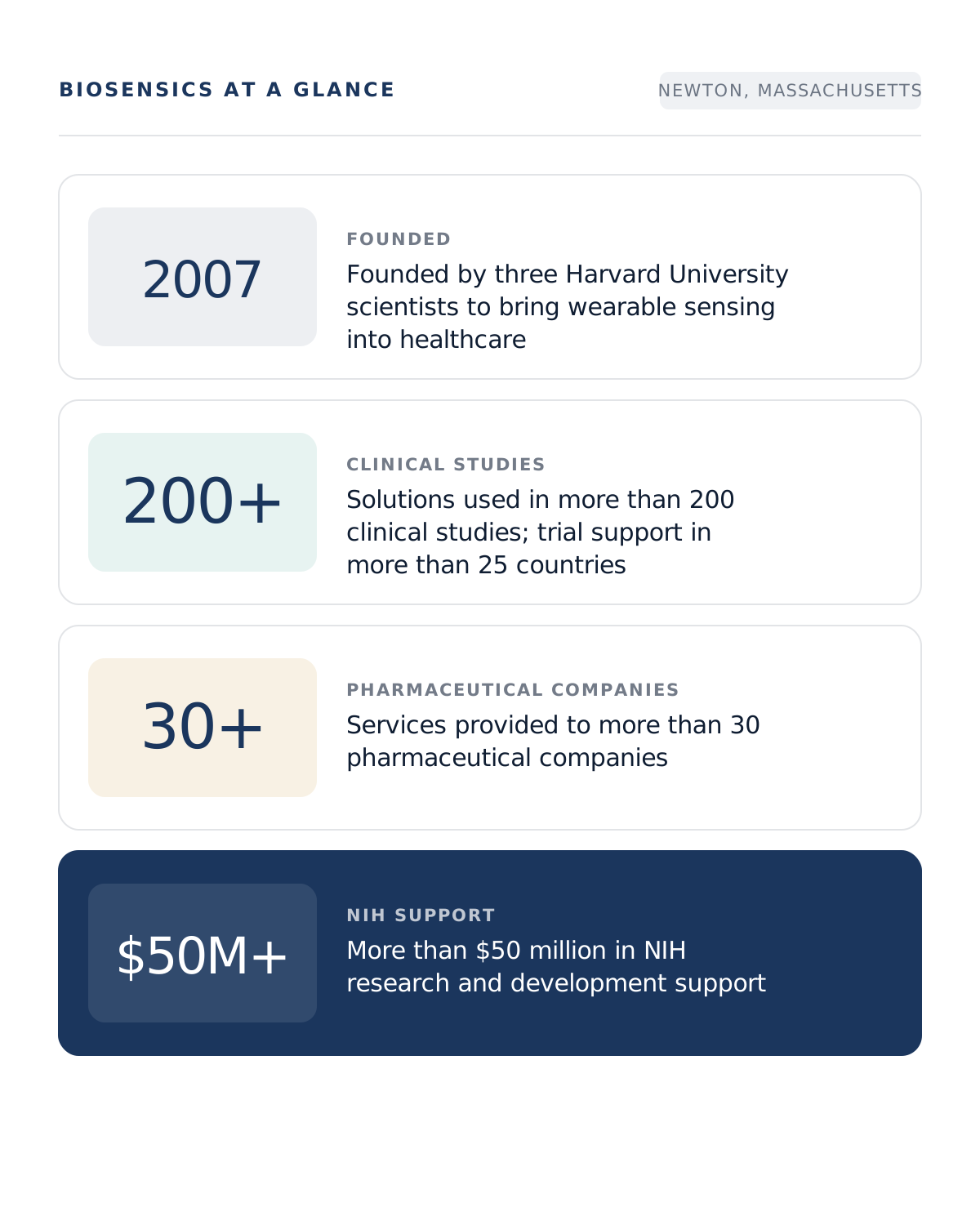
BioSensics develops technologies and provides services to measure function, develop endpoints, and generate evidence in clinical research. We work with pharmaceutical companies, academic medical centers, and patient organizations to connect digital measurements with clinical outcomes. Founded in 2007 by three Harvard University scientists, BioSensics is headquartered in Newton, Massachusetts.
NIH-supported research for rare disease clinical trials
In 2022, BioSensics received an NIH contract to develop and validate remote measures for rare disease clinical trials. The project brings together sensors and digital assessments to measure motor, speech, and cognitive function at home and in remote settings.
About us
BioSensics combines engineering, data science, and clinical research to measure function in the clinic and in daily life. We help sponsors develop endpoints and generate evidence relevant to their programs through natural history studies, analysis of existing BioDigit Database cohorts, and post-approval research. Studies can combine digital measures with clinical assessments and biological biomarkers, including blood biomarkers where collected. Our study operations, regulatory support, data analysis, and scientific reporting services guide this work from planning through interpretation.
Technology and expertise for clinical research
Technology, research data, and scientific and operational services to support clinical development.
-
Technology
Products
Wearable sensors, gait and balance systems, digital assessments, and platforms for collecting study data in the clinic and at home.
-
For sponsors
For Clinical Trials
Endpoint development, study operations, regulatory support, data analysis and scientific reporting, and post-approval evidence generation.
-
Research
Therapeutic Areas
Research and clinical studies across neurodegenerative, neuromuscular, and autoimmune disorders, with measures tailored to each indication.
-
Data
BioDigit Database
Digital, clinical, and selected biological data from research studies, with project-specific access and analysis to support endpoint development.
Milestones
Key developments in wearable sensing and clinical research since 2007.
-
2007
Founded by three Harvard University scientists
BioSensics was founded to bring wearable sensing into healthcare, with early work focused on supporting older adults in daily life.
-
2009
PAMSys released
BioSensics introduced PAMSys for monitoring physical activity and posture, laying the foundation for the PAMSys family.
-
2013
LEGSys released
BioSensics introduced LEGSys, a wearable system for quantitative gait assessment in clinical and research settings.
-
2017
BioDigit Home released
Released BioDigit Home to support remote, in-home clinical assessments.
-
2019
Predictive healthcare technology business acquired by Best Buy
Best Buy acquired BioSensics' predictive healthcare technology business. BioSensics continued its work in wearable sensors and digital technologies for clinical research.
-
2022
NIH contract for rare disease research
BioSensics received an NIH contract to develop and validate remote measures for use in clinical trials involving people with rare diseases.
-
2024
BioDigit Speech and BioDigit Cognition released
Released BioDigit Speech and BioDigit Cognition to support digital assessments of speech and cognitive function.
-
2025
BioDigit Video released
Released BioDigit Video to support video-based clinical assessments.
-
2026
LEGSys measures enter the FDA ISTAND program
FDA accepted the Letter of Intent for LEGSys-derived foot drop measures as longitudinal outcomes in adults with Charcot-Marie-Tooth disease type 1A (CMT1A). A qualification plan is the next step under the FDA ISTAND program.
-
2026
PAMSys accepted into the FDA ISTAND program
FDA has accepted PAMSys into the FDA ISTAND program as a drug development tool for measuring ambulation in progressive supranuclear palsy (PSP) clinical trials.
-
2026
BioSensics devices implemented in the PSP Platform Trial
Implemented BioSensics devices in the PSP Platform Trial (PTP) to support digital outcome assessments in progressive supranuclear palsy.
-
Today
Global clinical research
BioSensics solutions have been used in more than 200 clinical studies. The company has provided services to more than 30 pharmaceutical companies and supported trials in more than 25 countries.
Partnerships
We collaborate with academic investigators, patient organizations, and industry teams to design studies, evaluate digital measures, and translate findings into practical research tools. Partnerships can include technology integration, joint development, and research on shared scientific questions.
Research institutions
- Baylor College of Medicine
- Beth Israel Deaconess Medical Center
- Boston Children's Hospital
- Brigham and Women's Hospital
- Columbia University
- Johns Hopkins University
- Massachusetts General Hospital
- Penn State College of Medicine
- Spaulding Rehabilitation Hospital
- St. Jude Children's Research Hospital
- Stanford University
- University of California, Los Angeles
- University of California San Diego
- University of California San Francisco
- University of Hawaii
- University of Kansas Medical Center
- University of Miami
- University of PennsylvaniaIncluding the Perelman School of Medicine
- University of Rochester
- University of Sydney
- Vanderbilt University Medical Center
- Virginia Commonwealth University
Patient organizations
- ALS Association
- Association for Frontotemporal Degeneration
- CurePSP
- Friedreich's Ataxia Research Alliance
- Hereditary Neuropathy Foundation
- Huntington's Disease Society of America
- Lewy Body Dementia Association
- Muscular Dystrophy Association
- Myasthenia Gravis Foundation of America
- Myositis Support and Understanding
Careers
Work with engineers, scientists, and clinical research specialists to build technologies used in clinical studies. Explore opportunities across technical, scientific, and operational roles.
-
Open positions
Explore current opportunities on the BioSensics LinkedIn page.
-
Applications and inquiries
Email careers@biosensics.comSend your resume or a question about working at BioSensics to careers@biosensics.com.
Quality, security, and privacy
Quality management, data protection, and electronic-record controls for clinical research.
-
ISO 13485 certified
BioSensics maintains a quality management system certified to ISO 13485 by NQA.
-
FDA-listed devices
PAMSys and LEGSys are FDA-listed medical devices. Product-specific regulatory documentation is reviewed for the intended use and countries participating in a study.
-
HIPAA and GDPR
Data protection policies and security controls support applicable HIPAA and GDPR requirements. Drata supports monitoring and documentation of these controls.
-
Data Privacy Framework
BioSensics has self-certified to the EU-U.S. and Swiss-U.S. Data Privacy Frameworks and the UK Extension to the EU-U.S. framework, as described in its privacy notice.
-
Secure infrastructure
We use Aptible as part of our data-hosting infrastructure, alongside security controls and safeguards for study data.
-
21 CFR Part 11 and Annex 11
Electronic-record controls are assessed against applicable 21 CFR Part 11 and EU Annex 11 requirements for the configured system and study workflow.
Contact us
Contact our team for company information, study inquiries, or technical support.
-
General information
-
Technical support
-
Telephone
+1 (888) 589-6213
-
Mailing address
BioSensics LLC, 57 Chapel Street, Suite 200, Newton, MA 02458
Work with BioSensics
Connect with our team to discuss a study, a partnership, or career opportunities.