For clinical trials
Digital Screening for Clinical Trials
Use digital assessments to identify and characterize potential participants and support clinical eligibility review.
BioSensics brings speech, cognitive, video-based, and oculomotor assessments into study-specific screening workflows. Assessment batteries are configured around the target condition, relevant differential diagnoses, participant abilities, and protocol requirements.
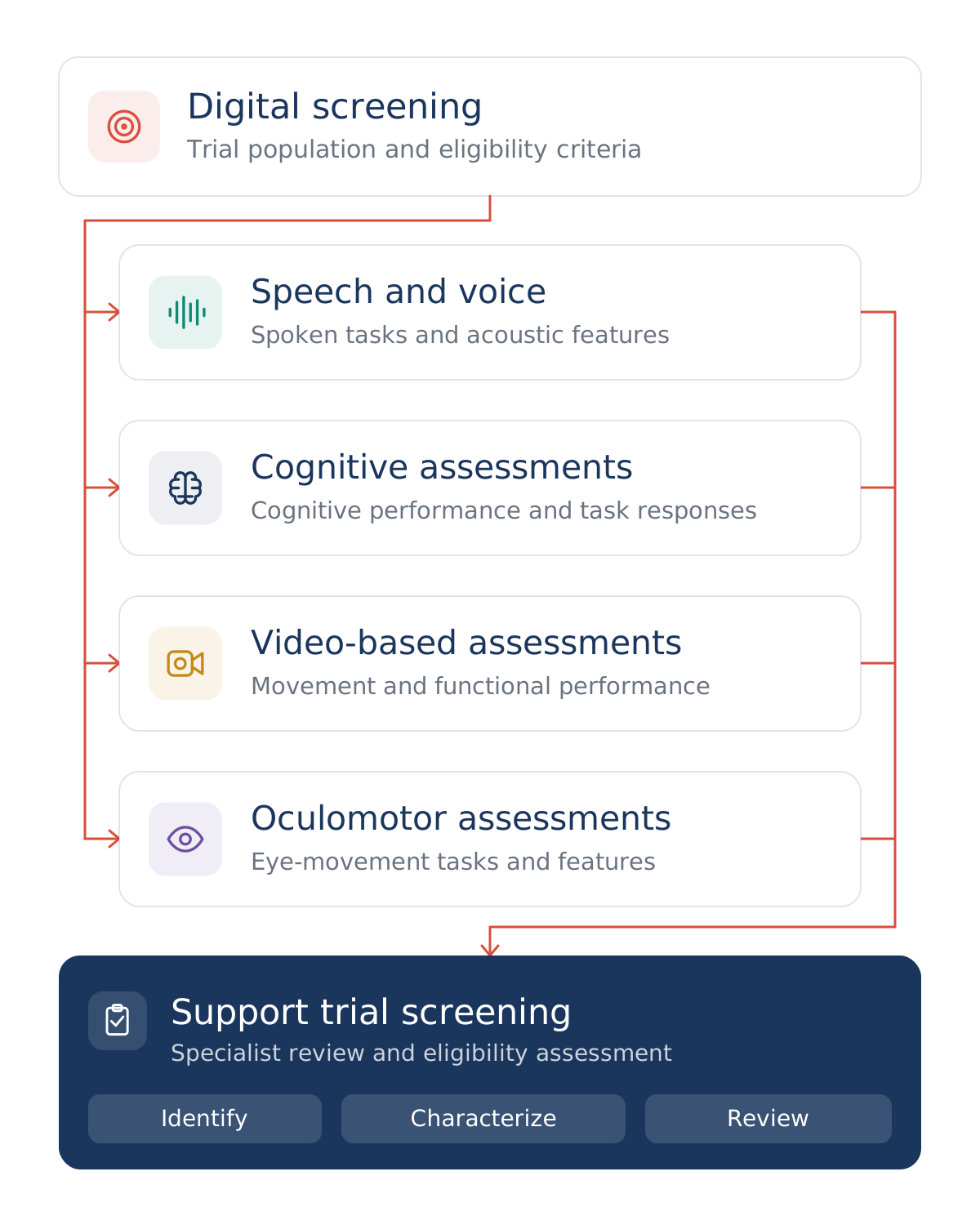
Identify candidates. Characterize participants. Support eligibility review.
Bring structured digital measurements into the clinical review of potential participants, with a consistent assessment process and clear interpretation for the study team.
Who is appropriate for your trial?
A diagnostic label alone may not describe the features that matter to a study. Digital assessments can add quantitative information about a candidate's speech, cognition, movement, and eye movements to the clinical review. The screening approach follows your target population, relevant differential diagnoses, protocol requirements, and the evidence supporting each assessment.
Four assessment approaches for your study
Use individual assessments or a complementary battery. Tasks, collection settings, and interpretation are selected for the clinical question and participant population.
-
Speech and voice
Structured speech tasks capture features of articulation, timing, fluency, and voice. These measurements can contribute to participant characterization and research into differences between clinical populations.
-
Cognitive assessments
Digital tasks characterize relevant aspects of cognition, such as processing speed, attention, working memory, and executive function. Task selection accounts for language, education, and motor or speech limitations.
-
Video-based assessments
Standardized recordings document selected motor and functional tasks for trained-rater review, automated analysis, or both. Consistent recording procedures support comparison across candidates and sites.
-
Oculomotor assessments
Eye-movement tasks characterize selected aspects of gaze and oculomotor performance. The recording method, quality requirements, and relevant features are matched to the study and available supporting evidence.
Support the decisions behind participant screening
Define the question each assessment will answer and how its findings will inform the clinical review.
-
Identify candidates for further evaluation
Use relevant digital findings to help flag candidates for specialist review when their presentation may warrant closer assessment of the target condition or a related diagnosis.
-
Characterize potential participants
Build a quantitative profile of relevant speech, cognitive, motor, and oculomotor performance. Document functional abilities, assessment quality, and findings that need additional clinical evaluation.
-
Inform eligibility review
Characterize protocol-relevant abilities and functional ranges alongside the clinical information required by the study. Investigators determine eligibility against the full inclusion and exclusion criteria.
A possible application is trial enrichment. Where study-specific evidence supports the intended use, screening measurements may also inform prespecified population criteria, such as a relevant functional range. Proposed criteria and their effects on representativeness are reviewed with the study team.
What your team receives
A defined screening workflow, interpretable measurements, and a clear record of what the evidence supports.
-
Screening strategy and assessment battery
A recommended set of tasks with a rationale for each assessment, its proposed role, and the evidence relevant to your population and setting.
-
Structured participant profiles
Configured measurements, assessment completion, quality indicators, and source recordings where included in the agreed scope, organized for authorized study-team review.
-
Review criteria and escalation pathway
Documented interpretation rules, responsibilities, and next steps for findings requiring specialist evaluation, repeat assessment, or additional clinical information.
-
Performance evaluation plan
A plan to assess feasibility, screening yield, and classification performance where applicable. Evidence gaps and any prospective validation needed before the intended use are identified explicitly.
From digital assessment to eligibility review
Integrate digital measurements into the study's existing clinical and recruitment workflow.
-
1. Define the population and question
Confirm the target condition, relevant differential diagnoses, protocol criteria, and the decision each assessment will inform. Review the supporting evidence and any validation needs.
-
2. Collect and check assessments
Configure tasks, instructions, and site or remote collection procedures. Review completion and recording quality before interpreting results.
-
3. Review the participant profile
Bring digital findings together with clinical history and other required assessments. Route uncertain or potentially relevant findings to the designated clinical reviewers.
-
4. Apply the study criteria
The study team reviews the digital findings alongside the required clinical evidence to determine eligibility against the protocol, with decisions and reasons documented.
Published evidence
A research example in progressive supranuclear palsy
A published BioDigit Speech study illustrates how digital measurements can contribute to research on differences between clinical populations.
Speech features and age in PSP and Parkinson's disease
A classifier evaluated in 21 participants with PSP–Richardson syndrome and 21 with Parkinson's disease achieved 85% balanced accuracy in leave-one-subject-out cross-validation.
This was an internal evaluation in clinically diagnosed participants. The study did not evaluate prospective trial screening, multiple system atrophy, or other PSP phenotypes. Its findings support further evaluation of digital speech for differential assessment.
Kang et al. Clinical Parkinsonism & Related Disorders, 2025.
Planning your screening approach
Does digital screening establish a diagnosis?
Digital findings provide additional information for clinical review. Diagnosis and eligibility decisions remain with qualified clinicians and the study team, using the required clinical assessments and protocol criteria.
Do all four assessment types need to be used together?
No. The battery is selected for the study question, participant abilities, and supporting evidence. Evidence for one assessment does not establish the performance of another assessment or of a combined model; each proposed use is evaluated separately.
Can digital screening also support trial enrichment?
Where evidence supports a specific use, screening measurements may help define prespecified enrichment criteria, such as a relevant functional range. Disease classification, expected progression, and treatment response are different uses. Selecting likely treatment responders requires predictive evidence for the intervention and population; it cannot be inferred from diagnostic classification performance.
How does this differ from Digital Endpoint Strategy?
Digital Screening for Clinical Trials focuses on who may be appropriate for a trial and how to characterize candidates. Digital Endpoint Strategy focuses on which outcomes to measure during the trial and how those endpoints should be defined and collected.
Can assessments be completed remotely?
Selected tasks may be collected remotely, at a study site, or through a combination of settings. The approach depends on the required equipment, recording quality, participant support, and evidence for the intended collection setting.
Build a screening approach around your trial population
Share your target condition, recruitment setting, and eligibility questions. We will help define the digital assessments, clinical review workflow, and evidence needed for your study.